Montessori Reading
Published on: March 20, 2026
Reading the Montessori Way: A Complete Guide to Teaching Your Child to Read
Teaching a child to read is one of the most rewarding milestones in a Montessori education — and it doesn't happen by accident. Dr. Montessori discovered that when children are given the right sensorial foundation, the right materials, and the freedom to explore language at their own pace, reading emerges naturally and joyfully. In this guide, I'll walk you through the Montessori approach to reading, from the earliest sensorial preparations all the way through phonograms and beyond. Whether you're a homeschooling parent or simply supplementing your child's classroom experience, these time-tested methods will help your child blossom into a confident reader.
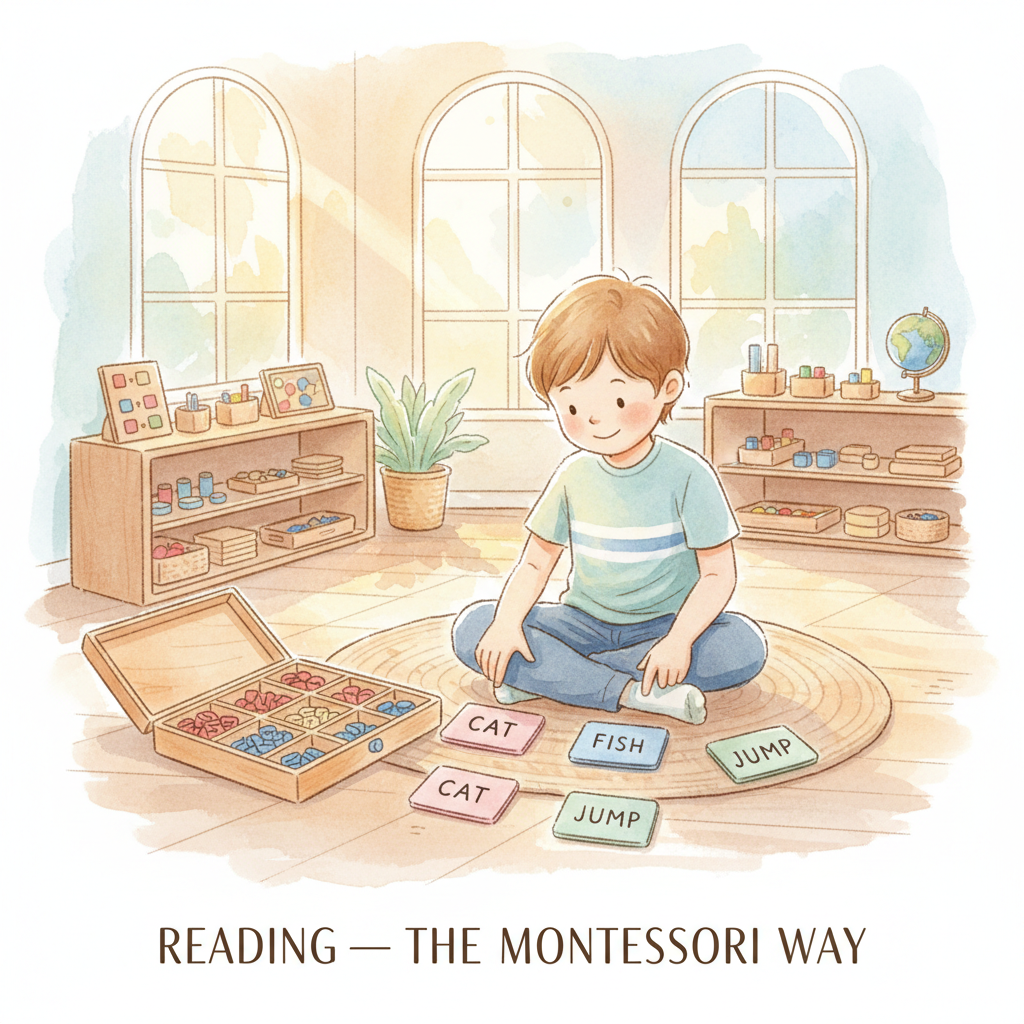
1. Reading the Montessori Way
The Sensorial Foundation
The sensorial lessons prepare your child for writing and reading. The concepts of comparing and contrasting shapes, colors, and ideas have been introduced and understood. Gradation of concepts and colors have also been practiced. The pink tower teaches comparisons of size and shape, and gradation of size. The colored spools teach the colors and concepts of grading from lightest to darkest. Then the words for these concepts are taught using the three-period lesson.
Another helpful lesson involves the basic shapes — square, triangle, circle, and rectangle. Tracing and drawing these shapes helps with writing and discriminating different shapes in letters.
Alphabet Mastery and the Moveable Alphabet
The sandpaper letters (or regular alphabet) should be mastered as well, using all the short vowel sounds and the hard consonant sounds. If you're looking for a quality set, the Elite Montessori Sandpaper Letters are a wonderful option for home use.
Spelling using the moveable alphabet usually follows. Children begin by spelling words using phonetic objects (cat, mat, pig, etc.) and then move on to spelling words using phonetic pictures. Even though a child can spell a word, in the beginning many children can't read the word they have spelled. Another exercise is to spell rhyming words, such as pig, wig, jig, dig or hat, cat, mat, sat.
And now, we are ready for writing and reading — child willing!
From Spelling to Sentences
Montessori included in reading the skills of writing, grammar, spelling, and comprehension. Some children who make sentences with the moveable alphabet will want to write out their sentences with paper and pencil. At this juncture, words such as "the" are introduced using the three-period lesson. It's a given that some words in English will have to be memorized for reading and spelling.
I usually have small blue books for writing down the sentences. I also provide art materials if the children want to draw pictures to illustrate their book. Also, have all the punctuation available for the moveable alphabet. Usually, the booklets are popular — children who want to just write words and illustrate can use the booklets too.
Reading with the Moveable Alphabet
Some children by this point know how to read and know all the sounds of the alphabet. Other children will need a review of all 26 letters and sounds of the alphabet.
At this juncture you can introduce cards, labels, and the moveable alphabet. A high-quality wooden moveable alphabet with box is well worth the investment for these exercises. You'll need 26 letters and 3 different pictures (2 of each item) glued on a card. Write the name of each animal on a label. For example, use 2 pictures of a pig, 2 pictures of a cat, and 2 pictures of an elk.
You can do this activity on a mat or a table — I use only one copy of the 26 letters of the alphabet for the first exercises. Take out the letters p-i-g-c-a-t-e-l-k and put them to the side.
Let your child match the pictures, spacing them so that there is room underneath each picture for a label and the letters from the moveable alphabet. Have your child put the proper labels under each picture. Then on the second identical picture, have your child take out the letters from the p-i-g-c-a-t-e-l-k letter pile and spell out the word on each unlabeled picture.
If this is difficult, you can label the first cards (like a nomenclature card) and let your child spell with the letters the word on the unlabeled card.
Labeling Objects in the Environment
Make labels for familiar objects in the room, such as dog, mat, hat, etc. Let your child match the labels to the objects. The objects in the beginning will be one pile and the labels in another.
Later on you can introduce words that end with -ck (duck, rock, etc.) then -ll (doll, ball, etc.).
2. Labeling Exercise for Non-Phonetic and Phonetic Words
Dr. Montessori used toys with labels for first reading exercises.
In The Montessori Method, she writes:
"We then put away the toys and set ourselves to make hundreds of written labels — names of children, of objects, of cities, of colours and of qualities made known through exercises of the senses. We placed them in more boxes and let the children search as they pleased among them. I expected that at least they would hunt indiscriminately and without any order in one box and in another, but no, every child finished emptying the box which he had under his hand, and only after that did he go on to another, truly insatiable for reading."
You can create your own farm labeling activity or use the reading object and picture boxes approach to bring this exercise to life at home.
Later on she explains:
"So we had nothing more to do but present them with a book; in fact they read the words in it."
How Long Does It Take a Child to Read During This Sensitive Period?
According to Montessori — 15 days!
"Experience tells us that, counting from the moment at which the child can write, the passage from this lower form of written language to the higher one of reading is an average about fifteen days."
But…
"Accuracy in reading, however almost always comes later than perfection in writing. In most cases the child writes very well and reads just fairly well."
She does say that children learn to read at different ages. Most Montessori children can read by the end of 2nd grade.
The 20 Isolated Sounds
Since the English language has 26 symbols and about 44 sounds, Montessori only introduces 20 isolated sounds. From her research she found that the 4- to 5-year-old group could remember 20 different sounds. Montessori, again, says to introduce labels to objects and items in the environment, but only those that are phonetic in the beginning.
Once interest and success is established, you go on to groups of words according to the spelling rules. She says in an insightful quote:
"In a word, one must proceed in the first instance with the aim of rousing keen interest in reading, and afterwards the way will be prepared for the long journey necessary to overcome the various difficulties of spelling. Then arises the necessity for research in grouping material objects and words corresponding to objects, making up a series of successive exercises. This leads the children to pure interest in reading words, as it is met with in phonetic languages.
In England, in adopting this procedure for the English language, it was found necessary to make small chests, which, in different drawers, contain groups of words chosen according to some spelling difficulties [phonogram] and groups of objects referring to them (as in the divisions for classification). The child can, after having taken a drawer from the chest, take out the objects himself, apply the label to each one, and having finished the work, replace it in the chest. He can then take another drawer, and so on. In this way he studies some of the difficulties relative to spelling and pronunciation."
— Discovery of the Child, M. Montessori
They actually had beautiful small, wooden chests with drawers for this in England. However, you can use shoe boxes for this activity or the small plastic chests with drawers.
Word and Object Box Ideas
Here are some beginning words and objects from the word list of phonetic words and phonograms. Put both the objects and labels in the same box:
- Words ending in -ll: doll, bill, pill (fake one, like a candy), gull
- Words ending with -ss: kiss (candy type), cross, lass, moss
- Words ending with -ff: muff, puff
- Words ending with -ing: king, wing, ring, sling
- Challenge words: button, cotton, mutton
You can use any phonogram category for the drawer or box exercises. Put one category — such as doll, bill, pill — in a box with the appropriate written label, and so on with the other boxes. As your child progresses, you can combine different word groups.
3. Pink, Blue, and Green Reading Lessons
The Montessori reading scheme is organized into three color-coded levels that progressively build your child's reading skills:
- Pink Series: Simple CVC (consonant-vowel-consonant) phonetic words — How to Make the Pink Reading Scheme
- Blue Series: Longer phonetic words with blends and consonant clusters
- Green Series: Words with phonograms and more complex spelling patterns
Explore More Reading Lessons
- Montessori Reading Cards
- Reading Cards
- Reading Command Cards
- Reading Vowel Lessons
- Reading Ideas
- Exercises with the Moveable Alphabet
- Life Cycle Reading Cards
4. Free Printable Reading Cards
Ready to get started? Download these free printable reading cards organized by the Montessori pink, blue, and green series. Simply print, cut, and laminate for durable materials your child can use again and again.
Pink Series (CVC Words)
- Pink Reading Cards – Set A (PDF)
- Pink Reading Cards – Set B (PDF)
- Pink Reading Cards – Set C (PDF)
- Pink Reading Cards – Set D (PDF)
- Pink Reading Cards – Set E (PDF)
Blue Series (Blends & Longer Phonetic Words)
- Blue Reading Cards – Set A (PDF)
- Blue Reading Cards – Set B (PDF)
Green Series (Phonograms)
- Green Reading Cards – Set A (PDF)
- Green Reading Cards – Set B (PDF)
- Green Reading Cards – Set C (PDF)
Additional Reading Cards
- Reading Cards (PDF)
- Gradation Reading Cards (PDF)