The Pink Tower
Published on: April 25, 2026
The Pink Tower
Ages
2½ to 4 years old
Material
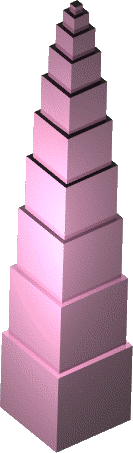
10 solid wooden cubes, varying in three dimensions from 1×1×1 centimeters to 10×10×10 centimeters. Each cube increases by exactly one cubic centimeter in each dimension. The pink tower is one of the most iconic pieces of Montessori sensorial equipment and is often the first material a young child encounters in the classroom.
Purpose
- Visual and muscular perception of dimension — the child experiences size differences through sight and touch
- Understanding of sequence and order by building graduated three-dimensional sizes
- Awareness of dimensions that leads to keen observation of the child's environment
- Development of smoother, more coordinated movement
- Math readiness — introducing concepts of smaller, larger, and preparing for the decimal and number system
Presentation
Spread a mat or rug on the floor — Dr. Montessori used a green carpet in her first school. Carefully scatter the cubes over the mat. Build a tower starting with the largest cube, choosing slowly and with deliberation.
Grasp each cube with one hand to get the muscular impression of size — the hand is visually measuring the cubes for the mind to process. Build the tower from largest to smallest. The child will probably not be able to grasp the largest cube with one hand, and it is perfectly fine to use both hands for that one. However, the remaining cubes should each be grasped with one hand.
Exercise
Your child builds the tower after the demonstration. Using the three-period lesson, introduce the concepts of large and small, then large, larger, largest and small, smaller, smallest. Understanding these degrees of comparison is essential for math readiness — it lays the groundwork for concepts like less and more, larger than, smaller than, and equal to.
The pink tower is also the first piece of math equipment in the Montessori classroom. When your child is ready, count the cubes from 1 to 10, starting with the smallest cube (1) up to the largest cube (10). The concrete difference in size between each cube helps young children see that each number gets bigger — putting together the concept of counting and value in an easy, tidy package. Most preschool children can recite numbers like memorizing a rhyme, but using the pink tower helps them truly understand the value behind each number.
Later, when you teach your child to count backwards, use the tower again. Count backwards from 10 (the largest cube) down to 1 (the smallest cube). This visual aid is invaluable for understanding subtraction.
Advanced Exercise
When the child can build the tower easily, have him or her build it with one corner exactly above the other all the way up — the two edges precisely even. The smallest cube can then fit on each ledge at every level, showing the exact size difference between each cube. Let your child use the smallest cube on each level to measure the difference.
This exercise also prepares the child for understanding cube roots. The largest 10th cube is made up of 1,000 of the smallest cubes. Eight of the smallest cubes make the second cube, 27 make the third, 64 make the fourth, 125 make the fifth, and so on. The cubes represent the concrete concept of the numbers 1 through 10 in three dimensions.
Your child can also combine the Pink Tower with the Red Rods and the Brown Stair. Comparing and noting differences between the three materials is a wonderful extension that deepens understanding of dimension.
Control of Error
If the tower is incorrectly built, it will topple over. The child can see and feel when a cube is out of place.
Helpful Hint
If the full tower is too challenging at first, give your child every other cube until he or she has mastered the exercise. Then add all ten cubes.
Free Printouts
Download these free Pink Tower printable activities:
- Pink Tower English Cards — Cards with English number names for matching with each cube
- Pink Tower Counting Cards — Counting cards from largest to smallest for sequencing practice
- Pink Tower Spanish Cards — Cards with Spanish number names for bilingual learning
- Pink Tower French Cards — Cards with French number names for bilingual learning
Explore more Pink Tower activities:
- Pink Tower and Counting — A math and reading activity using the Pink Tower
- Big and Small — Size comparison concepts using the Pink Tower
Related Sensorial Materials
The Pink Tower is part of a beautiful family of sensorial materials. Explore these related lessons:
- The Cylinders and Solid Insets
- The Red Rods
- Baric Tablets
- Colored Tablets
Recommended Materials
If you're adding a Pink Tower to your home classroom, here are two good options:
- Adena Montessori Pink Tower — Full-Size 10-Piece Set — 10 solid wood cubes graduated from 1cm to 10cm, the classroom standard size
- Kid Advance Montessori Pink Tower — 10 pink wooden cubes, a quality option for home use