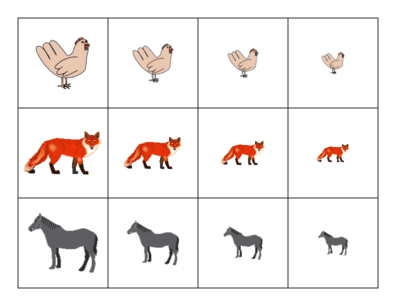
Montessori Sorting Largest to Smallest Printout
Published on: April 19, 2008
Montessori Sorting Largest to Smallest Printout
One of the most beautiful aspects of Montessori education is the way it transforms abstract concepts into tangible, hands-on experiences for young learners. Size ordering — the ability to arrange objects from largest to smallest or smallest to largest — is a foundational skill that supports mathematical thinking, visual discrimination, and logical reasoning. A simple printout activity designed around this concept can become a powerful learning tool in your home environment, and today we're going to walk through exactly how to prepare, present, and extend this activity for your child.
Why Size Ordering Matters in Montessori Education
In the Montessori classroom, size ordering falls under the sensorial curriculum, which is dedicated to refining a child's senses and helping them classify and organize the world around them. When your child arranges images or objects from largest to smallest, they are developing what Maria Montessori called the "mathematical mind." They are learning to observe differences, make comparisons, and establish a logical sequence — all precursors to more advanced mathematical concepts like seriation, measurement, and number sense. If you've been exploring Sensorial Activities with your child, you'll recognize that size ordering fits perfectly within this rich area of learning.
You may already be familiar with the iconic Pink Tower, which is one of the most recognizable Montessori materials for teaching size discrimination. A largest-to-smallest printout activity works on the same principle but in a two-dimensional, portable, and highly accessible format that's perfect for home use, travel, or reinforcement alongside classroom materials.
How to Prepare Your Sorting Printout Activity
Preparing this activity is simple and requires very few materials. Start by downloading or creating a printout that features a series of identical objects in graduated sizes — think stars, animals, leaves, or shapes. You'll want at least five to eight variations in size to give your child a meaningful challenge. Print the images on sturdy card stock paper so the pieces hold up well to little hands that will be picking them up, arranging them, and rearranging them repeatedly. For extra durability, especially if you have a toddler or plan to reuse the activity many times, consider running the printed sheets through laminating sheets to protect them from wear, spills, and sticky fingers.
Once your pieces are printed and cut out, place them in a small basket or tray on your child's shelf. In Montessori, presentation matters — a neatly arranged activity invites the child to engage with it independently and respectfully.
Step-by-Step Presentation Guide
- Invite your child: Calmly ask your child if they would like to do an activity with you. Carry the tray together to a workspace — a table or a floor mat.
- Introduce the pieces: Lay all the cut-out images on the mat in a random arrangement. Allow your child a moment to observe them.
- Model the activity: Slowly and deliberately, pick up the largest piece and place it on the far left. Then find the next largest and place it beside the first. Continue until all pieces are arranged from largest to smallest. Use minimal language — let your hands do the teaching.
- Invite your child to try: Mix the pieces up gently and invite your child to arrange them on their own. Resist the urge to correct immediately; self-correction is a cornerstone of Montessori learning.
- Introduce vocabulary: Once your child is comfortable, introduce terms like "largest," "smallest," "bigger than," and "smaller than" to build descriptive language skills.
Age Recommendations and Adaptations
This activity is ideally suited for children ages two and a half to five years old. For younger toddlers, start with just three to four pieces with very obvious size differences. As your child grows more confident, increase the number of pieces and reduce the size differences between them to sharpen their visual discrimination. Older children can be challenged to arrange pieces from smallest to largest, or even to order two sets of objects simultaneously. For more ideas on how to expand this type of work, browse our collection of Sorting Activities for additional inspiration and printable resources.
Tips for Success
- Follow the child: If your child wants to sort them in a different order or explore the pieces creatively, allow it. The exploration itself is valuable.
- Rotate themes: Keep interest alive by offering seasonal or thematic printouts — pumpkins in autumn, snowflakes in winter, flowers in spring.
- Create a control chart: Print an additional sheet showing the correct order so your child can self-check their work independently.
- Pair with three-dimensional materials: Use the printout alongside real objects like nesting cups or stacking rings to bridge two-dimensional and three-dimensional understanding.
Final Thoughts
A Montessori sorting largest to smallest printout may seem like a simple activity, but its educational value runs deep. It nurtures concentration, refines visual perception, builds vocabulary, and lays the groundwork for mathematical thinking — all while giving your child the joy of independent discovery. With just a few minutes of preparation, you can offer your child a meaningful learning experience that they will return to again and again. Trust the process, follow your child's lead, and enjoy watching those beautiful moments of understanding unfold.
Free Printout Downloads
Here are the free printable size boards and matching cards to set up this activity at home. Print them on card stock, cut out the strips and cards, and laminate for durability: