Montessori Baby — From Birth to 12 Months
Published on: March 22, 2026
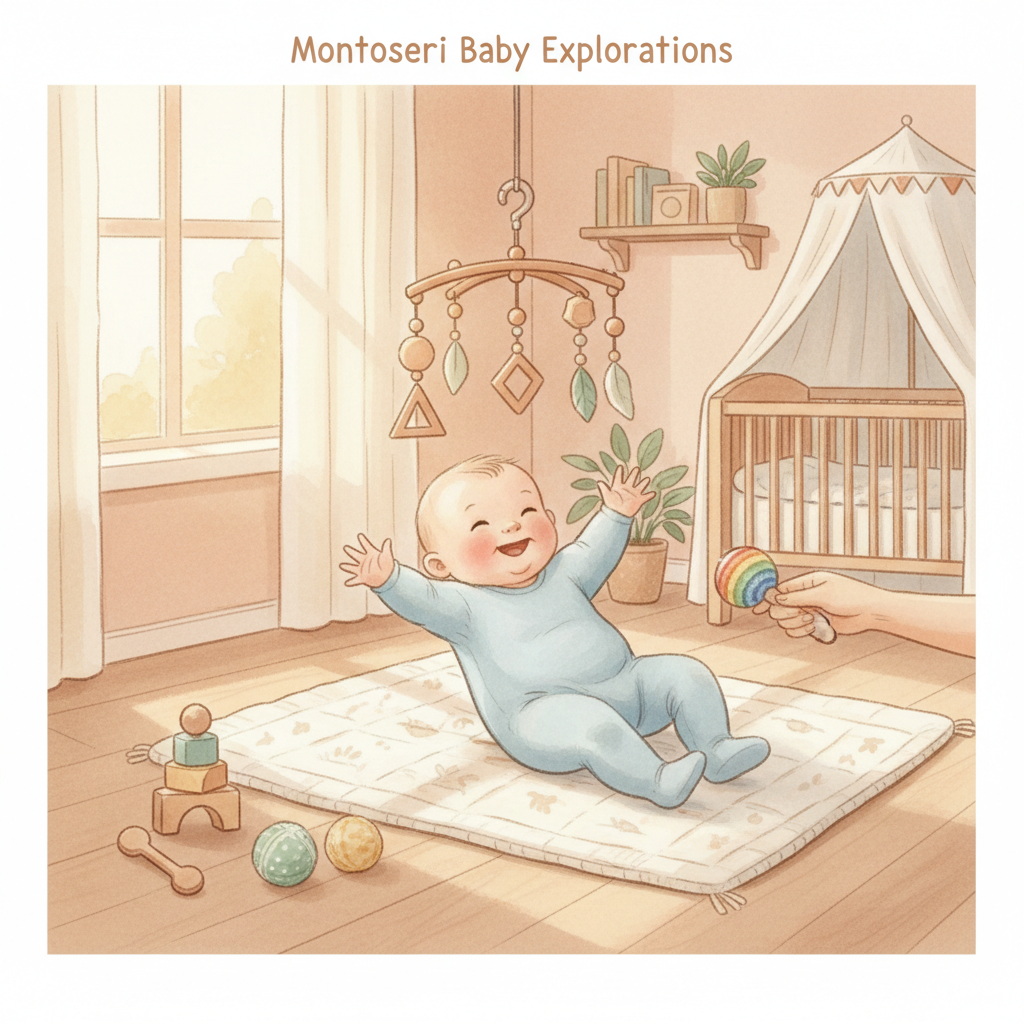
Babies are such delightful and mysterious creatures. One day your baby is lying on his or her back, and a few minutes later baby is two feet away on his or her tummy! The first activities we do with our babies are hold them, touch them, look them in the eyes, and talk to them like we have known them forever. Your love and attention helps your baby adjust to his or her new environment.
In Montessori, we believe that the infant is actively absorbing everything from the very first moments of life. Every gentle touch, every song, every warm conversation lays the groundwork for a lifetime of learning. This guide walks you through your baby's remarkable first year, stage by stage, with activities and ideas rooted in Montessori principles that you can start today.
Materials for Baby's First Year
- Soft textured toys and balls
- Simple wooden rattles
- Stacking blocks and cups
- Board books with vivid illustrations
- A safe "nest" with blankets in each room
- Musical instruments (simple percussion)
- Puppets and stuffed animals for dramatic play
- Easy-grip balls and shape sorters
- Push and pull toys for new walkers
Recommended:
- Montessori Sensory Toys Set (0-12 months) — Textured teething toys that stimulate tactile, visual, and auditory development.
- 6-in-1 Montessori Baby Toy Set — Includes building blocks, stacking cups, sensory balls, suction cup spinners, and pull string toy.
Birth to 3 Months
Babies who are held a lot, talked and sang to, and just well nurtured and loved tend to have higher IQs. There are studies that indicate that babies who get plenty to eat and have a good amount of body fat have higher IQs as well. By the time your baby is 3 months old, you can tell when your baby is hungry, tired, or in pain by his or her cry. Crying is the main form of vocal communication at this stage.
Cooing and communication: Cooing and making other noises is also a way your baby communicates. Respond to your baby's first communication! You can coo back or say "hi." Your baby will start playing this game with you if you encourage him or her by repeating it. The more you play the same game with your baby, the more complex the games will become. It's okay if you get blank stares in the beginning — just keep on talking and playing with your baby.
This is a great time to rock your baby and read a first illustrated book. Start by reading just one page. Simple finger plays and songs are also a wonderful activity. Hold your baby's hands or feet when singing finger plays and do easy movements.
Activities for 0-3 Months
Here are some things my 3-month-old babies loved to do:
- Bath time kicking: During bath time, babies love to kick their legs. Hold them securely in the water and say "kick, kick, kick!" when they start to kick. This activity helps later with swimming lessons. When bathing baby, make sure the room is nice and warm like the bath water — most babies cry when there is a big difference between the bath water and room temperature.
- Counting fingers and toes: When dressing baby, count their fingers and toes. Touch lightly each toe or finger you count. This is a wonderful bonding ritual and an early introduction to numbers.
- Make a nest in every room: One nest can be in a strong box with a soft blanket. Put safe toys around to look at and grab. Each nest can have different colored and textured blankets to sit on, with different safe items to hold or look at. Pull down the shade and let your baby look at shadows. Make sure you create a nest for your baby in a safe place in the kitchen — their sense of smell is very acute, and the kitchen is full of wonderful aromas!
- Art walks around the house: Take a walk around the house with your baby. Babies love to look at paintings on the wall — the more vivid and bright, the better. Hold baby close enough to see the painting, as babies are nearsighted. Take your happy baby to a family-friendly art gallery to look at paintings. They'll love it!
- Shadow play: Pull down the shade and let your baby observe the shadows that form. This is an early sensorial experience with light and dark.
4 to 6 Months
At 4 months, eye-hand coordination starts to develop. At first your baby will swipe at an object, but will eventually be able to grab it. Soft, textured objects are a great tactile experience. His or her reflexive grasp will also start to disappear at this stage.
You can start letting your baby grab different shaped and colored objects. Let your child grasp and hold as many safe objects as much as possible. This is the beginning of purposeful reaching, and every object your baby explores is building neural connections.
Activities for 4-6 Months
At six to seven months, your baby can hold up his or her head and look around quite well. They sit on your lap with a little support. This is a great time to play with your observant and captive audience!
- Pat-a-cake: Gently hold baby's hands and say, "Pat-a-cake, pat-a-cake, baker's man, bake me a cake as fast as you can!" This classic game builds rhythm, coordination, and social connection.
- Body parts fingerplay: Touch near baby's eye and say "eye blinker," point to nose and say "nose smeller," point to mouth and say "mouth taster," then gently tickle under the chin saying "chin chopper, chin!" Smile and softly laugh. Your baby will learn body awareness through this delightful game.
- Peek-a-boo puppet play: Take a puppet, cover its eyes, vary your voice, and say "Peek-a-boo!" This builds object permanence — the understanding that things still exist when you can't see them.
- Dramatic play with stuffed animals: Use a stuffed toy lamb and do a dramatic play with your baby. Say a fun "baa" sound for the lamb: "Mary had a little lamb, its fleece was white as snow" (hold up the lamb and say "baa!"), "and everywhere that Mary went, the lamb" (hold up the lamb and say "baa!") "was sure to go." You will get a few good laughs from yourself and baby too!
- Chewing and texture exploration: Babies love to chew and taste their toys. A good teething toy that baby can hold and chew is essential — you can take it anywhere for the occasional chewing party! Blankets with different textured squares also help with tactile development.
- Counting toes and fingers: As baby gets a bit older, you can use the toes and fingers to count: 1, 2, 3!
6 to 9 Months
Babies at 6 to 9 months are really listening to you and are much more attentive when you sing or read to them. It's fun to start using musical instruments during your play time with them. Hit the high note and sing baby's name, hit the low note and sing baby's name. You definitely will get a smile!
Make up stories using your baby's name and family members and friends. You can use objects to help illustrate the story, and your baby can handle the objects while you tell your story.
Activities for 6-9 Months
- Dump and fill: At this age, babies love to dump out containers of toys. While sitting in a high chair, they will play the "Pick Up What I Have Dropped Game" — or as I like to call it, "Hmm, gravity does exist!" Older babies love to crawl behind you after you tidy up the toys and dump everything out again! It is a process of learning: many parts equal the whole, gravity, noise makers, and more. It's easier to take out a puzzle, but much more difficult to put it together. Eventually, your baby will be able to put things back together.
- Stacking: Babies love to stack things at this age. Soft, stackable blocks are perfect — you can even make them yourself with material squares and stuffing!
- Musical exploration: Introduce simple percussion instruments. Sing songs, vary the pitch, and let baby experiment with making sounds.
- Storytelling with objects: Create simple narratives using familiar names and real objects baby can hold and explore during the story.
- Language games: My baby's favorite toy at this age was a toy phone. Yes, I do spend a bit of time on the phone! Babies are watching everything you do, and a toy phone lets them imitate your conversations.
9 to 12 Months
Nine to eleven month old babies love to play simple games, such as you rolling a ball to them. Choose a ball with openings that baby can really grab onto — this makes the game much more satisfying for little hands.
First puzzles that develop small motor skills are great for prewriting skills. They also help a child observe the differences in shapes and sizes, which indirectly prepares your baby for reading and math.
Activities for 9-12 Months
- Ball rolling: Roll a ball back and forth with your baby. An easy-grip ball with openings works best because baby can really grab onto it. This teaches turn-taking and cause and effect.
- Shape sorters and first puzzles: These develop small motor skills and help children observe differences in shapes and sizes — indirectly preparing them for reading and math concepts.
- Farm play sets: By 12 months, your baby will be able to grasp a variety of different-sized objects with eye-guided and purposeful reaching. A learning farm play set with different animals satisfies this phase of development beautifully.
- Push and pull toys: A walking baby loves pull-along toys and push toys. These encourage gross motor development and give new walkers confidence.
- Music and movement: Any percussion instrument or toy helps rhythm, coordination, and instills a love for music. Dance with your baby, clap along, and let them experiment with making sounds.
- Boxes and pots — "Will I fit in this?": Your child will squeeze into anything around the house! It's a great way to learn about size. Is this box big enough for me to fit in? How about this pot? The game goes on endlessly. Even toys are fair game!
Always continue to play with your baby, sing songs, read, do finger plays, and most of all take time for these precious moments. They go by so fast.
Key Montessori Principles for Babies
- Talk, sing, and read — constantly. Language development starts from day one. Your voice is the most important tool you have.
- Respond to communication. Every coo, cry, and gesture is your baby talking to you. When you respond, you teach your baby that their voice matters.
- Provide a prepared environment. Safe spaces with appropriate materials at each stage allow your baby to explore freely. The "nests" throughout your home are a perfect example of this principle in action.
- Follow the child. Observe what interests your baby and provide more of it. If baby loves kicking in the bath, make bath time a rich sensory experience. If baby is fascinated by your paintings, take a trip to the art gallery.
- Allow independence. Let baby grasp, reach, explore, and even make messes. The "dump and fill" game may try your patience, but it is building your baby's understanding of the world.
- Respect the process. It's easier to take out a puzzle than to put it together. Your baby is learning through repetition, and every time they dump, stack, drop, or reach, they are building cognitive pathways.
- Take time. These precious moments of baby's first year go by so fast. Be present and enjoy the journey.
What This Develops
- Sensory development: Textures, sounds, colors, shadows, smells, and movement all stimulate baby's rapidly developing brain. The different nests, textured blankets, and art walks provide a rich sensorial foundation.
- Gross motor skills: From kicking in the bath to crawling after toys to pushing and pulling, your baby builds strength and coordination throughout the first year.
- Fine motor skills: The progression from reflexive grasping to purposeful, eye-guided reaching is one of baby's greatest accomplishments. Grasping objects, stacking blocks, and working puzzles all refine these skills.
- Language development: From cooing games to fingerplays to storytelling, every verbal interaction builds the foundation for all communication and reading. Studies show infants have a keen memory for learning words.
- Cognitive development: Cause and effect (dropping from the high chair), object permanence (peek-a-boo), spatial awareness (fitting into boxes), and part-to-whole relationships (dump and fill) all develop through play.
- Pre-math and pre-reading skills: Counting fingers and toes, observing shapes and sizes in puzzles, and recognizing patterns in songs and fingerplays all lay groundwork for later academic learning.
- Emotional bonding and security: Secure attachment through responsive interaction — holding, nurturing, playing, and simply being present — gives your baby the confidence to explore the world.
- Musical intelligence: Rhythm, pitch, and coordination developed through songs, percussion, and movement activities create a lifelong love for music.
Related Articles
- Practical Life — the next stage as baby becomes a toddler
- Early Practical Life — bridging baby activities and toddler work
- Montessori Just for Baby — more baby-specific Montessori ideas
- Lesson of the Day 37: Baby Activities — activities for 5-8 month olds
- Apples, Fall and Fun for Baby — seasonal baby activities
- Practical Life Activities for Toddlers — next steps as your baby grows
- Sensorial Education in Montessori — the sensorial foundation that starts in infancy
- Toddler Scope and Sequence — planning the next stage of your child's Montessori journey