The Life Cycle of the Swallowtail Butterfly
Published on: December 20, 2009
The Life Cycle of the Swallowtail Butterfly
Introduction: A Window Into Wonder
Few things in nature captivate a child’s imagination quite like watching a caterpillar transform into a butterfly. The swallowtail butterfly — with its striking colors, elegant tail-like wing extensions, and fascinating defense mechanisms — offers one of the most rewarding life cycle studies you can share with your child.
In Montessori education, we follow the child’s natural curiosity, and there is perhaps no subject that sparks curiosity more reliably than a living creature undergoing transformation right before their eyes. If your child has already explored our Frog Life Cycle materials, studying the swallowtail butterfly is a beautiful next step.
Stage One: The Egg
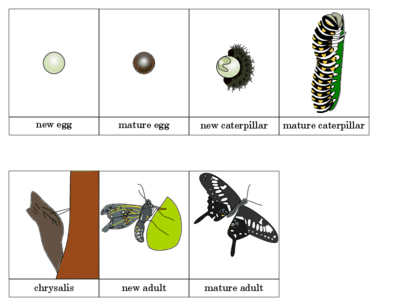
The swallowtail life cycle begins when a female butterfly carefully deposits her tiny, spherical eggs on a host plant. The Black Swallowtail, one of the most common species in North America, chooses plants in the carrot family — parsley, dill, fennel, and Queen Anne’s lace. Each egg is typically laid singly on the surface of a leaf, a pale yellow sphere no larger than a pinhead.
This stage lasts approximately four to ten days. Encourage your child to use a magnifying glass to observe these minute eggs. This kind of careful, focused observation connects beautifully with the skills developed through Sensorial Materials.
Stage Two: The Caterpillar (Larva)
When the egg hatches, a tiny caterpillar emerges. In its earliest instar (the term for each stage between molts), the swallowtail caterpillar is small, dark, and spiny, often resembling bird droppings. As the caterpillar grows and molts through five instars, it transforms into a plump, vividly green creature adorned with striking black bands and yellow or orange spots.
What makes the swallowtail caterpillar truly unique is its remarkable defense organ called the osmeterium. This bright orange, Y-shaped gland is hidden just behind the caterpillar’s head. When threatened, it rears up and extends the osmeterium, releasing a foul-smelling chemical that repels predators. Your child will be absolutely fascinated to learn about this dramatic defense strategy.
Stage Three: The Chrysalis (Pupa)
When the caterpillar has reached its full size, it stops eating and begins searching for a safe place to pupate. Rather than hanging upside down from a silk pad, the swallowtail chrysalis is held upright, attached to a twig by a silk girdle — a thin thread of silk that loops around the midsection like a tiny seatbelt.
Inside this seemingly still shell, the caterpillar’s body is dissolving and reorganizing itself into an entirely new creature through histolysis and histogenesis. This process takes approximately ten to fourteen days in warm weather. This stage offers a powerful lesson in patience for your child.
Stage Four: The Adult Butterfly
When the transformation is complete, the adult swallowtail butterfly emerges in a process called eclosion. At first, its wings are crumpled and wet. The butterfly pumps hemolymph through the wing veins, gradually expanding them to their full, breathtaking span of up to five and a half inches.
The adult butterfly’s primary purposes are to feed on nectar, pollinate flowers, find a mate, and lay eggs — beginning the cycle anew. If you and your child enjoy studying animal anatomy, our Parts of a Bird resource makes an excellent companion study, as birds are among the swallowtail’s primary predators.
Montessori Activities to Explore the Swallowtail Life Cycle
Create or print three-part nomenclature cards for each life cycle stage, along with key vocabulary like osmeterium, instar, proboscis, and host plant. Find printable sets in our Science Printouts collection, or pair them with life cycle figurines for a tangible, three-dimensional representation.
Invite your child to keep a butterfly observation journal. Each day, they can draw what they see, record the date, and note any changes. For additional nature-themed journaling pages, explore our Nature Printouts section.
One of the most magical experiences is raising swallowtail caterpillars at home. If you grow parsley, dill, or fennel in your garden, a Black Swallowtail may have already left eggs. A butterfly garden kit provides a safe, mesh habitat for observing every stage up close. This connects deeply to Montessori Practical Life values: your child learns responsibility by caring for a living creature.
Studying the swallowtail butterfly life cycle is an invitation for your child to slow down, observe closely, ask questions, and marvel at the complexity of the natural world. For further exploration, browse our full library of Zoology Printouts.
Related Articles
- My child cries every day before going to school. What can I do?
- What is Sensorial Education?
- Montessori Sensorial Education and Early Math Experiences