Newsletter (Beavers)
Published on: January 21, 2009
Beavers: A Montessori Nature Study
Beavers are one of nature's most fascinating engineers, and studying them offers children a wonderful window into ecology, animal adaptation, and the interconnectedness of living things. As semi-aquatic rodents, beavers spend their lives at the intersection of land and water — building dams, lodges, and canal systems that reshape entire landscapes. For children ages 3–9, a beaver unit study is rich with opportunities for hands-on learning, vocabulary development, and scientific observation.
About the Beaver
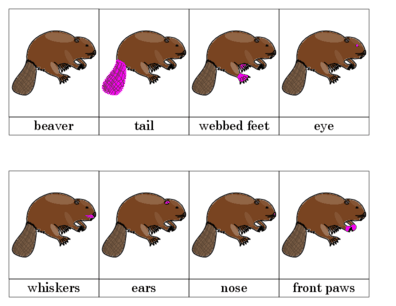
The beaver (Castor canadensis in North America and Castor fiber in Europe) is the second-largest rodent in the world. These remarkable animals are perfectly adapted to their semi-aquatic lifestyle: they have waterproof fur, webbed hind feet for powerful swimming, and a broad, flat tail that serves as a rudder in the water and a prop on land. Their large, iron-rich orange incisors never stop growing and are strong enough to fell trees — their primary building material.
Beavers are herbivores. Their diet consists of tree bark (especially aspen, willow, and birch), aquatic plants, grasses, and roots. In autumn, beaver families stockpile branches underwater near their lodge entrance, creating a food cache they can access throughout the winter even when the pond surface freezes over.
Ecosystem Engineers
Scientists call beavers a keystone species because their dam-building activities create wetland habitats that benefit countless other organisms. When a beaver family dams a stream, the resulting pond provides habitat for fish, amphibians, waterfowl, and insects. The wetlands filter water, reduce erosion, and recharge groundwater. Studying beavers gives children a concrete, vivid example of how a single species can shape an entire ecosystem — a concept that aligns beautifully with the Montessori emphasis on the interconnectedness of all life.
Using Nomenclature Cards in Your Study
Montessori nomenclature cards (also called three-part cards) are a cornerstone of the language and science curriculum. Each set includes a picture card with a label, a picture card without a label, and a separate label card. For younger children (ages 3–5), begin by presenting the picture-with-label cards and naming each part of the beaver. Older children (ages 5–9) can match the picture cards to the labels independently, then use the control card to self-correct.


Seriation & Size Comparison Activities
The "Largest to Smallest" cutouts connect to the Montessori sensorial curriculum. Children as young as three love arranging objects by size, and these printable cutouts let them practice seriation with real animals.
Nature Study Connections
Pair this beaver study with an outdoor nature walk near a stream, pond, or wetland area. Look for signs of beaver activity: gnawed tree stumps, dams made of sticks and mud, or the dome-shaped lodge rising above the water. For more nature study ideas, visit our Nature Studies — Squirrels, Beavers lesson page.
Recommended Materials
Enjoy your beaver studies! There is something deeply satisfying about watching a child discover how one small animal can reshape an entire world of water and woods.